


Daily POP Crossword Puzzles
Puzzle Nation Apps
I approached Daily POP Crossword Puzzles as a quick word game rather than a serious crossword-training tool, and that distinction matters. Its appeal is the familiar crossword grid paired with clues drawn from pop culture, so the experience feels lighter and more conversational than a traditional newspaper puzzle. I could pick it up for a short break, solve a few entries, and stop without feeling that I had started a long commitment.
The game is free to download and is suitable for Everyone, which makes it easy to recommend to families, casual puzzle players, and anyone who enjoys entertainment trivia. It is developed by Puzzle Nation Apps and has built a solid audience, with more than one hundred thousand installs and an average rating of 4.2 from roughly 5,700 ratings. Those figures suggest a game with broad everyday appeal, although they do not change the fact that the best experience depends heavily on whether its pop-culture clue style matches your interests.
What to expect when you open the game
The central idea is straightforward: solve crossword puzzles whose clues lean toward movies, television, music, celebrities, and other recognizable parts of popular culture. That focus gives the game a different personality from a general-purpose crossword app. Instead of relying only on vocabulary, obscure geography, or formal wordplay, it invites you to remember names, titles, characters, catchphrases, and cultural references.
That makes the first few minutes relatively welcoming. If you already enjoy entertainment trivia, a clue can trigger an answer quickly even when the crossing letters are limited. If your interests do not overlap with the puzzle’s subject matter, the same clue may feel arbitrary rather than challenging. I found that the game is most enjoyable when I treated each puzzle as a mixture of word solving and memory recall, not as a pure test of spelling.
The short description calls it “Daily POP Crossword,” and the daily framing is useful for setting expectations. This is the kind of game that fits naturally into a routine: a morning coffee, a commute when you are not driving, or a few quiet minutes before bed. I would not choose it when I want a deep, multi-hour puzzle session. Its strength is accessibility and repeatable short play rather than a highly elaborate adventure around the grid.
Related News






Because it is a word game, the basic skill is not speed alone. You need to recognize a clue, enter an answer, and use crossing letters to narrow down the uncertain parts. That loop is familiar enough for crossword newcomers, but the pop-culture theme gives it a more relaxed tone. A player who normally avoids classic crosswords may find this approach less intimidating because the subject matter feels closer to everyday entertainment than to a formal vocabulary exam.
Who is likely to enjoy it
I would point first-time players toward this game if they like trivia but do not want a complicated ruleset. It also works well for people who enjoy comparing answers with friends or family, since a clue about a familiar show or performer can prompt an immediate conversation. The Everyone content rating makes it a reasonable shared choice, though individual enjoyment will still depend on personal familiarity with the references.
It is less suitable for someone looking for cryptic crosswords, advanced wordplay, or a carefully structured language course. It is also not my first recommendation for a player who wants a completely neutral word list without entertainment themes. A standard crossword alternative may be better if you prefer clues based on general knowledge, literary vocabulary, or more traditional puzzle conventions.
Gallery
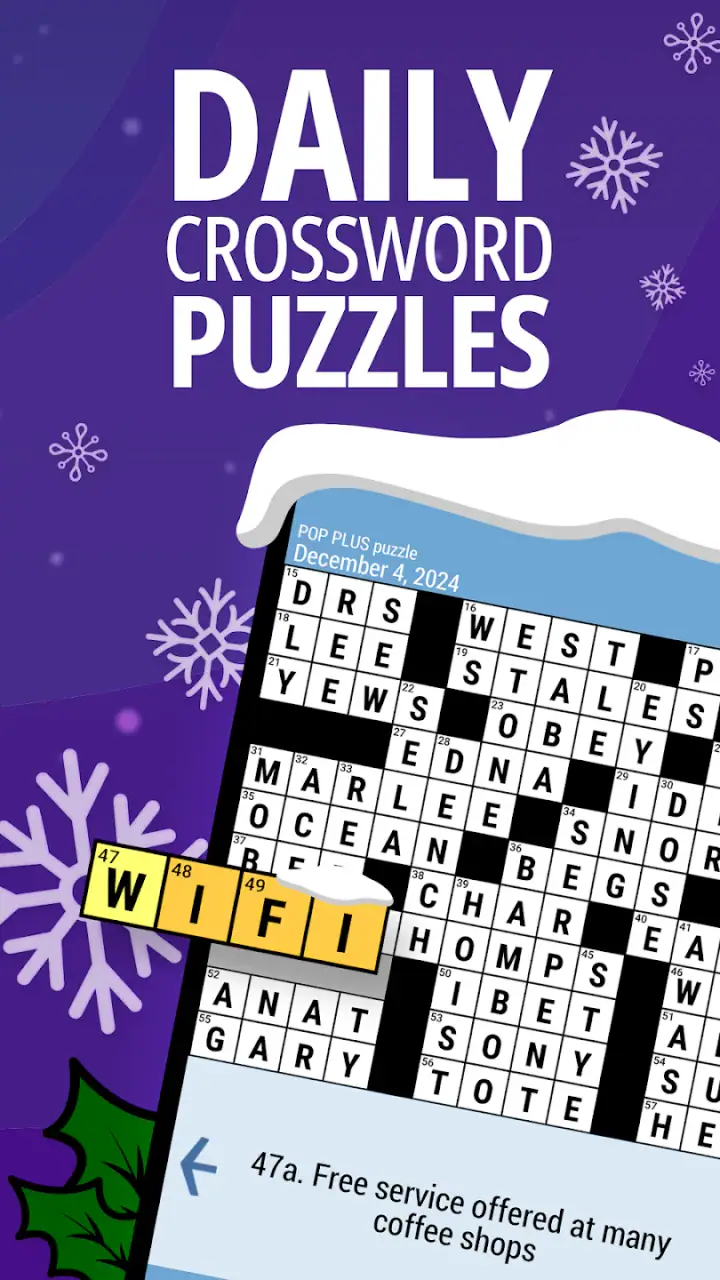
Another important trade-off is the role of memory. A player with strong spelling but little interest in pop culture may struggle more than expected, while someone who follows entertainment news may solve clues quickly without needing advanced crossword technique. That unevenness is not a flaw in itself, but it means difficulty can vary according to your background rather than following a smooth learning curve.
Getting started without overthinking the first puzzle
The first setup is simple in practical terms: install the free game, open it, and begin with the available crossword experience. The current version is 4.2.4, and it runs on devices using operating system version 9 or later. Before installing, I would check that your phone or tablet meets that minimum requirement, especially if you keep an older device for casual games.
I recommend starting without trying to solve every clue in order. Crosswords reward movement around the grid. Begin with the clues whose answers feel obvious, enter those letters, and then return to the entries that looked vague. One certain answer can transform several difficult clues because the crossing letters give you a much narrower set of possibilities.
For a first session, I would also avoid treating an unanswered clue as a personal failure. Pop-culture puzzles often contain references that are easy for one player and unfamiliar to another. Mark the uncertain area mentally, continue elsewhere, and come back after the grid has supplied more letters. This approach is more efficient than repeatedly staring at the same clue with no new information.
There is a useful distinction between recognizing an answer and spelling it correctly. I sometimes knew the performer, title, or character being referenced but hesitated over the exact letters. In those moments, the crossing entries are especially valuable. They can reveal whether the answer uses a shortened form, a plural, or a spelling that differs from the way the name sounds when spoken.
Your first meaningful success
The first satisfying milestone is not necessarily completing an entire puzzle. It is solving a cluster of connected entries by using crossings deliberately. I would begin with the shortest clues that seem familiar, then work outward from the letters they create. When several answers connect, the puzzle starts to feel less like a wall of trivia and more like a conversation between clues.
For a realistic first attempt, imagine opening the game during a ten-minute break. You recognize one clue about a television title, enter it, and gain a few letters in the intersecting answers. One of those letters makes a music-related clue obvious, while another narrows down a celebrity name. Even if a few squares remain blank when the break ends, you have learned the main rhythm: secure what you know, use the grid as evidence, and postpone guesses that have no support.
My most useful practical tip is to avoid filling a plausible answer too early when it conflicts with an existing crossing letter. Pop-culture clues can produce several answers that seem reasonable, especially when a title or name is shortened. If the grid disagrees, trust the letters first and reconsider the clue. This prevents one attractive guess from sending you down the wrong path across multiple entries.
A second tip is to read the clue’s wording carefully instead of searching only for the subject. A clue may point toward a person, a work, a role, or a phrase connected with that person. Identifying the general topic is only the first step; the grammatical shape of the clue helps determine what kind of answer belongs in the squares.
A third tip is to use the game as a memory prompt rather than immediately reaching for outside help. When I pause and recall where I have seen a name or title before, the answer often returns after a few crossing letters appear. That small delay makes the eventual solution more rewarding and helps build familiarity with the puzzle’s style.
Where new players may hesitate
The most common confusion is expecting every clue to test ordinary vocabulary. This game’s pop-culture identity means that knowing the definition of a word may not be enough. You may instead need to identify a title, a performer, a fictional character, or a phrase associated with entertainment. If a clue feels strangely specific, that is usually a signal to think in terms of cultural references rather than dictionary meanings.
Another possible sticking point is perceived inconsistency in difficulty. One puzzle can feel gentle because its references are familiar, while another can become difficult quickly if it touches an area you do not follow. I would not judge the whole game from a single frustrating grid. The subject-based nature of the clues naturally creates peaks and valleys, and the crossing letters are designed to help smooth those differences.
It is also easy to confuse speed with quality. A fast solve can be satisfying, but taking longer does not mean the game has failed you. For a casual word game, the better measure is whether the puzzle gives you enough information to make progress without turning every clue into a guess. I found that a slower, deliberate solve was more enjoyable than racing through familiar answers and becoming annoyed by the unfamiliar ones.
Players should also keep the free-to-play structure in mind. The game is free, but it includes optional in-app purchases ranging from $0.99 to $49.99 per item. That wide range means I would review any purchase prompt carefully and decide whether it genuinely improves my experience. If you only want occasional crossword sessions, the free starting point may be all you need. If you play frequently, set your own spending limit before buying anything so convenience does not quietly become the main part of the experience.
I would not install this game expecting a completely offline, distraction-free crossword book in digital form. A physical book offers a different kind of focus and has no purchase prompts or changing app version to consider. On the other hand, this game is easier to carry, quicker to start, and more approachable when you want entertainment-themed clues instead of a fixed collection of printed puzzles.
How it compares with familiar crossword alternatives
Compared with a traditional newspaper crossword, this game feels more casual and more dependent on entertainment knowledge. A newspaper-style puzzle may reward broad vocabulary, wordplay, and general knowledge across many subjects. Daily POP Crossword Puzzles narrows the identity of the clues, which can make the game more inviting for pop-culture fans but less satisfying for someone who wants a varied intellectual challenge.
Compared with a word-search game, it asks more from your memory and inference. A word search gives you a visible collection of letters and usually focuses on finding rather than deducing. Here, the answer has to emerge from the clue and the crossing pattern. That makes each solved entry feel more meaningful, although it also creates more moments where you may need to leave a clue unfinished.
Compared with a trivia quiz, the crossword grid adds a useful second layer. You are not simply choosing an answer from a list; you must fit the answer into a specific pattern and spelling. This can rescue you when your memory is incomplete. You may remember part of a title or name, and the grid can help reconstruct the rest. In a quiz app, an uncertain answer is often simply right or wrong; in a crossword, partial knowledge can still move you forward.
Compared with an advanced crossword app, this is the option I would choose for a lighter routine rather than serious training. Someone preparing for difficult tournaments or seeking dense cryptic clues should look elsewhere. The pop-culture focus is its defining advantage and its main limitation at the same time: it gives the game a clear voice, but it also restricts how broadly the puzzles can appeal.
Small habits that make the game better
I suggest playing with a pencil-and-paper mindset even on a phone. Do not feel obligated to commit to the first answer that comes to mind. Use the crossing pattern as a check, and let uncertain clues remain open while you build confidence elsewhere. This reduces the frustration caused by an answer that looks right but later blocks several connected entries.
It can also help to separate knowledge gaps from spelling gaps. If you do not recognize the reference at all, more letters may be needed before the clue becomes meaningful. If you recognize it but cannot remember the spelling, focus on the pattern created by the crossings. Treating those as different problems makes it easier to choose the right response: patience for the first, and careful letter checking for the second.
For shared play, I would use the game as a conversation starter rather than turning it into a competition. One person may know music references while another remembers television characters, so solving together balances different strengths. That is a particularly good use case for a family or casual group because the puzzle can remain social even when one player does not know every answer.
For solo play, a short daily routine is more realistic than promising yourself long sessions. Open it when you genuinely want a mental break, solve the entries that come naturally, and stop before the experience becomes forced. The game is at its best when it fills a small gap in the day, not when it is treated like a demanding obligation.
My recommendation after using it
I came away seeing this as a friendly, focused word game for people who enjoy entertainment references and want an uncomplicated way to solve crosswords. Puzzle Nation Apps has chosen a clear theme rather than trying to appeal equally to every kind of word-game player. That focus gives the experience personality and makes the first successful solve feel accessible, especially when you use crossing letters instead of guessing blindly.
The free entry point is a strong reason to try it, and the Everyone rating makes it easy to consider for shared casual play. The current version, 4.2.4, supports the straightforward modern presentation I would expect from a maintained mobile game, while the app’s average rating of 4.2 shows that many players find the format worthwhile. I would still keep the optional purchase range in mind and avoid assuming that every extra is necessary for enjoyment.
I would recommend it to a first-time crossword player who likes pop culture, to a trivia fan looking for a more structured challenge, or to anyone who wants a short puzzle during a quiet break. I would skip it if your priority is cryptic difficulty, broad academic knowledge, or a completely theme-neutral crossword collection. In those cases, a traditional crossword source is likely to suit you better.
My practical next step would be to install it, open the first puzzle, and aim only to solve a connected group of clues rather than finish everything immediately. Start with the references you recognize, let the letters guide the uncertain answers, and judge the game after you have experienced that loop. If the combination of familiar entertainment topics and gradual deduction feels satisfying, this is a low-pressure crossword habit worth keeping; if the references feel disconnected from your interests, no amount of persistence will make its central theme the right fit.
FAQs for Daily POP Crossword Puzzles
What is Daily POP Crossword Puzzles?
Daily POP Crossword Puzzles is a mobile word game built around crossword challenges inspired by popular entertainment, celebrities, television, music, movies, and other parts of pop culture. Each puzzle usually combines familiar trivia with traditional crossword solving, making it appealing to players who enjoy both vocabulary and entertainment-themed questions. The app is designed for short daily sessions, although additional puzzles or features may be available depending on the version and subscription options.
Is Daily POP Crossword Puzzles free to download and play?
The app can generally be downloaded at no initial cost, but free access may be limited to selected puzzles, daily content, advertisements, or certain gameplay features. Depending on the platform and current version, optional in-app purchases or a subscription may unlock extra puzzles, remove advertising, or provide broader access to the puzzle library. Before confirming a purchase, review the store listing and subscription terms carefully.
Does the game require an internet connection?
An internet connection may be needed to download the application, load new daily puzzles, display advertisements, synchronize progress, and process subscriptions or other purchases. Some previously loaded puzzles might remain playable offline, but this can vary by device and app version. If you plan to play while traveling or without mobile data, open the app beforehand and check which puzzles are available for offline use.
Are the crossword puzzles suitable for beginners?
Daily POP Crossword Puzzles can be approachable for beginners because the clues are often connected to recognizable pop-culture subjects, and players can gradually become familiar with the game’s clue style. However, difficulty may vary considerably depending on the topic and the player’s knowledge of celebrities, shows, films, music, or current entertainment. Hint features can help, but frequent use may be restricted or tied to advertising or paid options.
Is Daily POP Crossword Puzzles appropriate for children?
The game may be suitable for older children and teenagers who enjoy word puzzles, but parents should check the current age rating, advertising content, privacy information, and the subjects featured in the clues. Pop-culture references can include celebrities, relationships, television programs, films, or other themes intended for a general adult audience. In-app purchases may also be available, so parental controls are recommended on shared devices.
Pros
- Fresh crossword puzzles are added regularly for daily solving.
- Clean interface makes clues and answers easy to read.
- Helpful hints can assist when you get stuck on a difficult clue.
- Puzzles are suitable for both casual players and crossword fans.
- Progress tracking encourages you to maintain a solving routine.
Cons
- Some puzzles may feel too easy for experienced crossword players.
- Hints or extra puzzle content may require in-app purchases.
- An internet connection may be needed for new puzzle downloads.
- Small text can be uncomfortable on phones with compact screens.
- Ads may interrupt play
- depending on the version or subscription.


